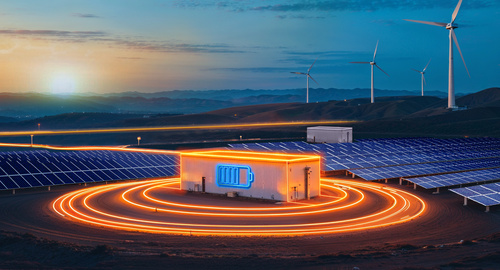
In its study titled 24/7 Renewables: The Economics of Firm Solar and Wind, the International Renewable Energy Agency (IRENA) calculated for the first time the project-specific costs of converting volatile solar power into a continuous supply. These costs are much more relevant for a round-the-clock renewable energy supply than the pure levelized cost of electricity (LCOE) of PV.
The result: In sunny regions with favorable framework conditions, the combination of photovoltaics (PV) and battery storage systems (BESS) can already be more cost-effective than a new coal- or gas-fired power plant.
The levelized cost of electricity has documented the global rise of renewables. In 2024, the average cost of solar power was 44 US dollars per megawatt hour worldwide, with 91 percent of newly built utility-scale renewable capacity generating electricity at a lower cost than the least expensive fossil fuel alternative. However, this figure only indicates the average cost of producing electricity per megawatt hour – not when the electricity is generated. Project planners, whose revenues are being squeezed by falling spot prices, are finding it increasingly difficult to rely on these parameters. Even when it comes to providing cost-effective electricity to households, businesses and industry, the LCOE from volatile generation sources fails to capture the bigger picture, since all these sectors require a reliable supply. Until the cost of supply security is quantified, any debate over the energy transition is missing a critical piece.
Until now, assessing the cost of round-the-clock supply has required elaborate models of the entire power system – too complex for the day-to-day work of project planners, investors and policymakers. Instead, IRENA calculates costs based on individual projects, referring to the result as the firm LCOE. For selected sites, the study calculates which combination of solar capacity and storage provides the most cost-effective, consistent supply, with a default reliability target of 95 percent.
The study examined several locations, including Nevada, the Tabernas Desert in Spain, Hebei in North China, the Thar Desert in Rajasthan, Bahia in Brazil, South Africa’s North West province, the interior of Oman and southern Queensland, as well as 252 Chinese solar parks that went online in 2024. The selection is based on two criteria. First, these are sites with very high solar irradiance – the natural starting point for testing whether firm solar power can be competitive – and they are also home to the majority of the world’s population. Second, they feature a broad variety of framework conditions: China demonstrates what is possible with domestic manufacturing and cheap financing, while the United States shows how capital costs, grid charges and approvals can drive up the final price. This reveals how much of the cost comes from technology – and how much from site and regulation.
On top of the standard costs of the solar installation, a firming premium is included for all assets required to ensure a firm supply, such as storage systems and generation overbuild through additional solar capacity. The constant supply profile is a modelling assumption. It reflects what steady off-takers, such as data centers or industrial companies with a continuous consumption, contractually demand.
A 100-megawatt plant in Las Vegas illustrates just how important the design is. A four-hour storage system is enough to cover 80 percent of demand; the cost of electricity remains below 80 US dollars per megawatt hour. At 85 percent and above, costs rise sharply: Each additional percentage point requires a disproportionately large amount of storage to fill the last few rare gaps – the battery wall. Instead, it can be more cost-effective to design a larger solar installation. This would make 95 percent coverage achievable at around 113 US dollars. This means that storage alone is the most expensive option, while a combination of overbuilding and BESS is the most feasible.
Abu Dhabi provides a real-world example: The Al Dhafra complex combines 5.2 gigawatts of PV with 19 gigawatt hours of storage to steadily deliver one gigawatt of output – at an estimated 70 US dollars per megawatt hour.
Since 2020, firm costs at prime locations have fallen by about 31 percent, dropping to between 54 and 82 US dollars per megawatt hour. They are expected to decrease by nearly half again by 2035. The reason for this is that between 2010 and 2024, PV became 87 percent cheaper and BESS 93 percent cheaper; in 2025, turnkey systems saw a further price drop of around 30 percent.
In contrast, new coal-fired power plants cost 70 to 85 US dollars in China, while new gas-fired power plants cost over 100 US dollars worldwide. In China, firm solar power already falls well below these costs.
In Europe, another effect may be even more important than the price. Storage systems smooth out feed-in peaks, allowing existing grid connections to handle significantly more solar capacity – up to five times as much, according to Ember. In countries with long waiting lists for grid connections, this can be the fastest way to increase generation. Australia and Portugal are already taking advantage of this approach.
What matters more than a system’s average annual generation is how long its low-generation periods last. A site with several consecutive overcast days requires significantly more storage than one with consistent weather – even if both deliver the same amount of power over the course of a year. Batteries can reliably cover the daily cycle, but dry spells lasting several days push them to their limit.
The most effective solution is a mixed portfolio. Solar and wind naturally complement each other’s generation profiles. In the United Kingdom, both sources fall short simultaneously on only two percent of days. IRENA quantifies the effect: Compared with relying on a single technology, using both sources together reduces costs by around one-third without compromising supply security. The most cost-effective plants for firm supply therefore combine both, where resources allow.
An important observation from IRENA is that no power system needs every plant to be a round-the-clock supplier. Reliability is created through the interplay of grids, storage, flexible demand and controllable generation, which often makes it cheaper. For most commercial off-takers, a reliability target of 80 to 90 percent is the most cost-effective compromise.
First, the speed: Solar installations with storage are typically up and running within one to two years after approval and grid connection, whereas, according to S&P Global, the wait time for turbines of gas-fired power plants alone is five to seven years. Second, the pricing: Firm solar power is priced based on plant and capital costs rather than fuel costs, decoupling it from global markets.
Whether this potential is realized depends less on the technology than on the rules governing electricity procurement. In its tenders, India specifically requires suppliers to guarantee that their portfolio delivers a minimum amount every hour. Recent auctions thus achieved around 95 percent availability for less than 60 to 65 US dollars per megawatt hour. In China, storage systems were once a requirement for grid connection – the mandate was dropped in March 2025 because the domestic industry no longer needed it.
IRENA’s firm LCOE methodology is important because it makes it possible to calculate the cost of a continuous renewable power supply while accounting for availability. It simplifies the work of project planners and gives society and the economy a realistic sense of the costs involved. However, it falls to policymakers to put the right framework conditions in place so the most cost-effective firm LCOE technologies can prevail. The smarter E Europe continues to advocate for Renewables 24/7 and brings together key stakeholders through its annual alliance of exhibitions to enable a future powered entirely by renewable energy.