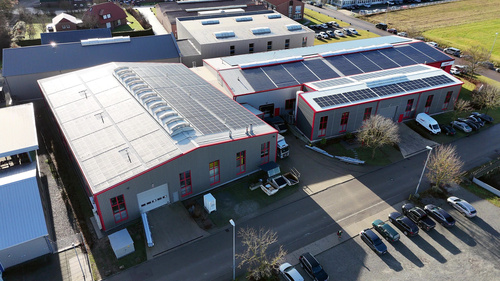
High electricity costs are taking a toll on many businesses. The metal fabrication and equipment manufacturer MAW Eckartshausen shows how they can escape the cycle of rising costs. For about a year, a PV installation and a commercial storage system, controlled by a smart energy management system, have helped the company reduce grid-purchased electricity by a quarter.
How can businesses with high energy demand reduce costs? In November 2025, MAW Eckartshausen, a metal fabrication and equipment manufacturer based in Ilshofen, Baden-Württemberg, Germany, addressed this challenge by combining a 256-kWp photovoltaic installation with a 215-kWh battery storage system. To bring this plant to life, project planner ingenia worked closely with meteocontrol and Huawei, which supplied the commercial storage system and PV-inverters.
The challenge was to connect the PV and the storage system in such a way that as much solar power as possible would be used directly within the company, reducing the electricity consumption from the public grid and allowing excess energy to be fed in flexibly. At the same time, the plant has to fulfill the grid operator’s requirements and enable surplus feed-in within the framework of direct marketing.
To achieve this, meteocontrol designed a hybrid energy management system to control photovoltaic and battery storage systems and integrate them into the grid. It coordinates the energy flows between the installations and the grid connection, ensuring that solar power is first used on site or stored in a battery. Only surplus energy that cannot be used locally or stored is fed into the grid. The electricity can be marketed seamlessly via an integrated interface with the direct marketer.
Meteocontrol preconfigured the controller and delivered it as a ready-to-connect switching cabinet. This significantly reduced on-site installation time and accelerated start-up. A cloud-based monitoring software gives the operator a centralized view of energy flows between the PV system and the battery storage system.
The first operating data demonstrates how well the interaction works in practice. By using and storing self-generated solar power, the metal fabrication and equipment manufacturer was able to reduce its purchased electricity from the public grid by about a quarter.
MAW Eckartshausen’s project shows how PV, battery storage and energy management can be combined into a scalable system. By integrating these technologies, businesses can become more self-sufficient through solar power while also giving them greater flexibility in managing generation, consumption and grid feed-in.
For more information on this project and other inspiring best-practice examples from the industrial, commercial, residential and mobility sectors, visit:
Best Practices für die Sonderschau „Renewables 24/7“