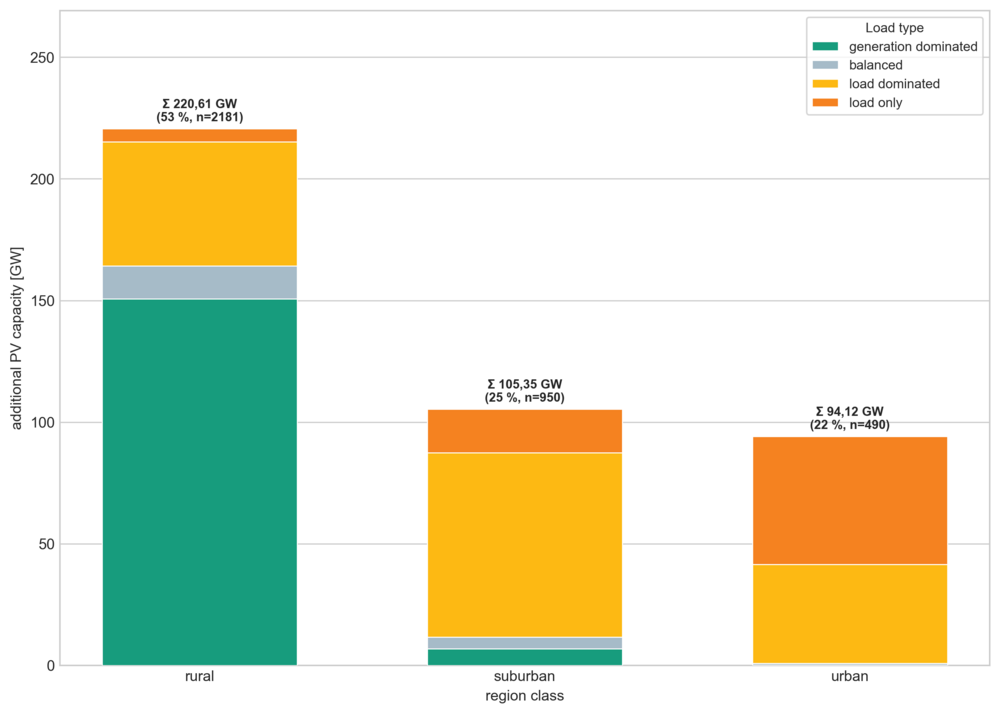
Intelligently controlled large-scale battery energy storage systems (BESS) could improve the utilization of existing grid connections and enable additional photovoltaic (PV) capacity. A study conducted by Fraunhofer IEE on behalf of the German Solar Association (Bundesverband Solarwirtschaft) estimates the technical potential at approximately 150 GW of additional PV capacity across 1,313 selected rural substations in Germany with a high share of renewable energy generation.
The scenario combines this additional PV capacity with 60 GW of battery storage power capacity and 240 GWh of energy storage capacity. The findings highlight the opportunities created by intelligently integrating solar power generation, battery storage, and existing grid infrastructure.
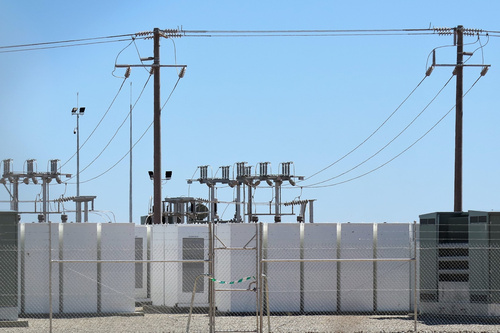
Substations connect different voltage levels within the power grid. Transformers adjust voltage levels so that electricity can be transmitted through the corresponding power lines. Together with line capacity, transformer capacity limits how much electricity can be fed into the grid and transmitted onward at any given time. Because grid utilization fluctuates throughout the day and across the year, some existing grid capacity remains temporarily unused.
This is where combining PV systems with battery storage comes into play. Rather than sizing new solar installations solely according to available grid connection capacity, developers can install more PV capacity than the grid connection can accommodate simultaneously under peak-generation conditions. This approach, known as PV overbuilding, is combined with a battery storage system that absorbs excess solar power and feeds it into the grid later, when grid capacity becomes available again. Intelligent control coordinates generation, storage, and grid feed-in.
This approach can improve transformer utilization and enable additional PV installations without necessarily requiring a corresponding expansion of grid capacity. In the study's reference scenario, the combined installed generation capacity of existing renewable energy installations and additional PV systems amounts to 200% of the rated capacity of the respective transformer.
For 1,313 selected rural substations in Germany, the study identifies a technical potential of approximately 150 GW of additional PV capacity. The corresponding reference configuration includes 60 GW of battery storage power capacity and, assuming a four-hour storage duration, 240 GWh of energy storage capacity.
The modeling results also show that, in the reference scenario examined, curtailment of the additionally installed PV systems due to transformer capacity constraints could be limited to an average of approximately 1% of their annual electricity generation. Curtailment occurs when a solar installation is temporarily required to feed less electricity into the grid than it could generate because the grid cannot fully absorb or transmit the available power. Battery storage absorbs some of this surplus energy and makes it available for grid feed-in at a later time.
The 1% curtailment rate reported in the study applies exclusively to transformer-related curtailment of the additionally modeled PV installations. It does not include other potential energy yield losses, such as battery storage losses, market-driven curtailment, or grid constraints outside the substation under consideration.
These findings underscore the importance of coordinating PV overbuilding, battery storage sizing, and intelligent operational control. The key factor is not simply the installed battery capacity, but also when the battery charges and discharges and how its operation is coordinated with actual grid utilization.
For the study, Fraunhofer IEE first analyzed real-world operating data from 20 transformers at 13 substations within the grid areas operated by Pfalzwerke Netz AG and Westnetz GmbH. Based on this analysis, the researchers simulated various scenarios, comparing different levels of PV capacity, battery storage sizes, storage durations, and operating strategies. The objective was to determine how additional solar power generation could be integrated while reducing curtailment caused by transformer capacity constraints.
The researchers then extrapolated the results to 1,313 rural substations across Germany with a high share of renewable energy generation, using comparable site characteristics, generation profiles, and load characteristics. These findings provided the basis for estimating the nationwide technical potential.
The results show that large-scale battery storage can do more than shift electricity consumption and generation over time or respond to electricity market price differentials. Under suitable conditions, battery storage can also help improve the utilization of existing grid connections and enable additional generation capacity. This creates an opportunity for project developers, battery storage integrators, and grid operators to jointly optimize the sizing and operation of PV systems and battery storage from the early planning stages.
However, the extent to which this potential can actually be realized depends on local grid conditions, technical feasibility, and the commercial viability of individual projects. The study provides an estimate of technical potential, not a comprehensive economic feasibility analysis.
In addition, the study did not include detailed power flow calculations or grid constraint analyses for upstream and downstream voltage levels. The results therefore primarily describe the potential at the level of the substations and transformers examined. They should not be interpreted as a general confirmation that the full 150 GW of additional PV capacity could be connected immediately. Potential constraints elsewhere in the power grid and the actual availability of suitable land were also not fully accounted for.
Looking ahead, the further expansion of the battery storage market will depend in part on the site conditions, market environments, and business models under which combining PV systems with large-scale battery storage proves commercially viable at individual locations. The study outlines a technical pathway: smarter utilization of existing grid infrastructure could create additional headroom for renewable energy deployment.